Our research revealed eight leadership success patterns – read more about the contextual leadership practices and how CLAI can support the patterns

Successful leaders do not rely on speed alone; they create moments to think before acting and to learn after acting. Yet experience can easily turn into autopilot if leaders stop testing whether their assumptions still hold in a changing situation. A deliberate reflection practice improves judgement by challenging familiar responses, interpreting weak signals and learning from reactions after interventions. That strengthens focus, improves decision quality, and ensures stronger execution. Use CLAI to build structured pre- and post-decision reflection into your leadership rhythm to handle shifting priorities, leadership dilemmas, performance issues, and transformation, and to ensure critical thinking in your decision-making. Read the full article on the Leadership Success Pattern #1: Make Reflection a Recurring Practice.
Successful leaders are authentic and bring their values and integrity into leadership. Yet, they deliberately continue to adjust what they emphasise through their leadership to drive results. They see their personal leadership as a source of shifting organisational beliefs and behaviours, choosing periods when they drive specific agendas by explicitly emphasising a few priorities. They understand that shifting the leadership focus co-exists with authenticity and results in stronger followership and better organisational performance. Use CLAI for sparring on how to drive followership and ownership through your personal leadership – also when the agenda must shift, or transformations hit your organisation. Read the full article on the Leadership Success Pattern #2: Be Authentic, But Push the Agenda.
Successful leaders understand people well and create the conditions for high engagement. At the same time, the reason for having leaders is to maximise the return on people. So, these leaders understand leadership is not primarily about accommodating employee preferences; it is about leading 51% from the organisational intentions and business priorities, and 49% from empathy, support, and relational understanding. This balance creates a shared focus so efforts are continuously re-aligned to the organisational priorities. It establishes clear, shared expectations for what good performance looks like. The result is stronger ownership and execution. Use CLAI for sparring on balancing care and commitment, aligning expectations, and leading from the organisational intentions without overstretching people. Read the full article on the Leadership Success Pattern #3: Understand Why We Have Leaders.
Successful leaders know that culture shapes how work gets done. Also, that culture is not something you simply live with; when strategy shifts, the beliefs and habits that once supported performance can begin to hold it back. By clarifying what the updated agenda requires, involving people in interpreting what that means for daily work, and following up on commitments, these leaders turn culture into a practical guide for decision-making, collaboration, and handovers. That builds stronger ownership, accountability, and cross-functional coordination, which improves execution when work becomes more interdependent. Use CLAI to identify the subcultures your strategy depends on and drive effective involvement that results in commitments that shift the culture to fuel performance. Read the full article on the Leadership Success Pattern #4: Shape the Culture.
Successful leaders create predictable ways for information to move through the organisation so decisions are prepared rather than improvised. They recognise that many leaders get trapped in meetings and escalations and conclude they “don’t have time” for reflection, preparation, and longer-horizon thinking. The successful leaders carve out the time and insist on a fit-for-purpose rhythm – individual preparation time and leadership team cadences that connect business reviews, leadership meetings and reporting timing. This rhythm reduces rework and constant realignment, builds accountability and empowerment, and creates the capacity to handle truly unusual incidents. Use CLAI as an active co-thinker embedded in the rhythm to secure preparation standards that go beyond short-term reactions and habit responses. Read the full article on the Leadership Success Pattern #5: Build a Management Rhythm.
Successful leaders create clarity about how work flows across functions and how decisions are made. In this respect, processes are a strong basis for effective collaboration in an empowered organisation – especially in a matrix or widely distributed organisation. When leaders put lean, fit-for-purpose processes at the centre, they create a shared frame for decision-making, reduce unnecessary stakeholder involvement, and operationalise the basis for effective coordination. This empowers people to move fast with clarity, consistency, coordination and without endless meetings – also when the external environment is dynamic and complex. Use CLAI for sparring on mapping core processes, clarifying mandates, determining information flows, and building a discipline culture to make them work in practice. Read the full article on the Leadership Success Pattern #6: Empower Coordination with Processes.
Successful leaders continuously pursue business growth and optimisation. At times, by leading larger business transformations, and continuously by developing their people to develop the business. They know not to treat development as an employee offer or a backfilling exercise, but as an agenda linked to future business needs. They create continued development through task exposure, rotation, mentoring, and clear learning expectations. They know expertise and change readiness are built through experience long before a capability gap becomes urgent. Also, they lean in and actively lead their people through change when bigger transformations are on the agenda. Use CLAI to turn people development into a business development agenda and for sparring on handling change reactions, leading change, and creating breakthroughs in transformations. Read the full article on the Leadership Success Pattern #7: Drive Change & Develop Your People.
Successful leaders create clarity about why the organisation exists and what it is trying to achieve. They recognise that effective leadership is not about setting direction alone, but also about involving the people who execute in interpreting that direction into operational objectives and committing to the right actions. When leaders facilitate a shared line of sight from results to execution to enablers, people can use their expertise with more ownership, better judgment, and stronger followership. This improves alignment, decision quality, collaboration, and execution. It also reduces drift, ambiguity, and suboptimisation. Use CLAI to clarify purpose and objectives, involve teams in ways that yield clear commitments, and build stronger ownership to drive execution on the actions that matter most. Read the full article on the Leadership Success Pattern #8: Lead from Purpose and Objectives.
The Research behind CLAI
Leadership context is the sum of factors holding the potential to influence leadership or its outcomes. Leadership outcomes are defined as the work performance behaviour and the engagement drivers behind the behaviour, which are most suited to promote the organisational culture, intentions and ambitions.
A global leadership context study involving more than 125 leadership experts confirmed a range of factors with guiding, helping and hindering effects.
The factors organise themselves into five layers of leadership context, which interact in a force field. The five layers of leadership context are briefly introduced hereunder.

The intentions concern the organisation’s mission, vision, strategy and operational priorities, tasking the leader to promote the fit-for-purpose performance in her part of the organisation.
The layer of organisational intentions exercises a significant guiding effect on leadership priorities and approaches. It determines which work performance behaviour is most important for the leader to promote.
Over time, the organisation can shift the balance between efficient operation and the energy invested in innovation forth and back. In both instances, the leader needs to interpret these intentions into effective leadership.
Based on an interpretation of the intentions, she should build engagement and promote the behaviour yielding the highest possible performance, rather than “just” lead as usual. Another vital part of the organisational intentions in the leadership context is the strength of the organisation’s purpose.
The leader must understand how to let the purpose permeate leadership and strengthen the organisational culture leading to high performance. There are significant differences in how central organisations hold their purpose, and it is the leader’s task to understand how to convert purpose into pride and meaning through effective leadership.
The environment comprises the external factors surrounding the leader’s organisation or team. The layer concerns factors in the market and the society exercising an influence on the organisational performance.
An organisation is nested into a broader market and societal system, and the level of openness between the organisation and its external environment sets the tone for how direct an influence the external factors exercise.
These factors are often outside the leader’s control. A leader needs to build collective awareness of the best contingent responses to the external environment, especially when certain factors hold the potential to exercise significant influence.
For example, when operating in an environment with high complexity and high dynamism or working in environments with severe threats which can manifest anytime, the leader should train and operate by standard contingent responses to make the organisation contextually effective.
Such contingencies build organisational capability to mitigate or leverage the effects of external risks, dynamic market movements, high external complexity or other external factors.
The structures in the leadership context are the layer of organisational design, processes, policies and procedures.
It lays out essential parts of the organisational playing field. For example, an effective leadership team should consider how the level of formalisation and the choices of what is centralised and what is delegated best reflect the current organisational intentions.
The structures hold great potential to help or hinder effective contextual leadership. The structures and the cultures can substitute a part of a leader’s direct leadership interventions in pursuit of organisational performance.
Contextual leadership is about setting the leadership context up to promote engagement and performance within an organisational context. It concerns leveraging the context to allow the leader to invest her leadership efforts in the highest-return areas. Thus, it is fascinating for any leadership team to consider aligning organisational intentions, structures and cultures.
In most cases, there will be parts of the structures, for example, specific corporate policies and procedures, which a leader does not hold a mandate to shape. However, often there are malleable parts of the structures that allow a leadership team to optimise their leadership context to best support performance — for example, formalising selected standards for work processes, communication or coordination.
The cultures represent the fourth layer of leadership context and concern the “way we do things around here” — the organisational habits and beliefs built over time.
There is more than one culture at play in a leadership context. Each of these cultures is related to particular functions in the organisation.
Examples are the safety culture, the collaboration culture and the learning culture. These cultures need to be understood in relation to the prioritised organisational intentions to promote performance optimally.
The organisational culture can be shaped through effective leadership interventions and close collaboration with the significant employees in any team.
An effective contextual leader also considers how shaping structures and changing the composition of people help build the best possible cultures for the organisation’s purpose and intentions.
The global leadership context study confirmed 12 such focused cultures, all significantly related to performance and malleable through leadership. The cultures offer a carrier wave that can extend the leadership influence when shaped in close collaboration with significant followers.
On the other hand, if the cultures are misaligned with the organisational intentions, the effects can hinder performance significantly. Hence, it is a vital part of contextual leadership to shape the cultures essential to value creation.

What Is Contextual leadership?
Effective contextual leadership is about recognising which parts of the leadership context are most important when choosing leadership interventions, shaping structures and cultures, and adjusting the team to perform.
Contextual leadership is about setting the leadership context up to promote engagement and performance. It concerns leveraging the context to allow the leader to invest her leadership efforts in the highest-return areas. Thus, it is crucial for any leadership team to consider aligning organisational intentions, structures and cultures.
Contextual leadership is when a leadership team with high contextual awareness makes choices that set the organisation up to perform — when the leadership team paves the way and strengthens the contextual factors that help performance emerge.
Shaping the leadership context
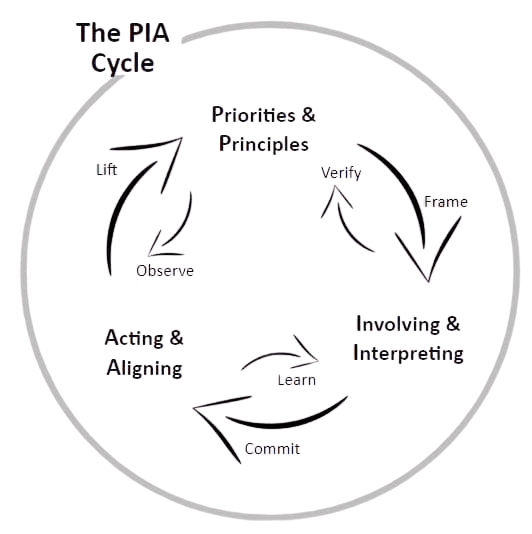
The global leadership context study confirmed a three-step cycle at the heart of being a contextually effective leader — the PIA Cycle.
Firstly, understanding the Priorities and Principles related to any contextual factor is necessary for being contextually effective. Recognising “what is at play” is critical, whether it concerns understanding the vital part of the organisation’s strategy, key factors in the external environment or part of the existing cultures.
Secondly, the factors at play need to be Interpreted by Involving the team to uncover what effects the contextual dynamics will result in. The interpretation is about uncovering which helping, hindering and guiding effects the factors at play will trigger — and which balances they will shift. It is about committing to actions that will mitigate contextual influence and changing habits that can shape the context to promote performance.
Thirdly, converting the interpretation into Actions that can leverage the helping effects, mitigate the hindering effects and convert the guiding effects into appropriate actions. It is about Aligning behaviour through direct leadership or by shaping the leadership context. The global leadership context study confirmed the pattern across organisational, functional and national differences.
There are nuances to applying the three-step process depending on which part of the leadership context is being addressed. The method is unpacked in the book The Contextual Leader, along with insights into the different contextual factors, their effects and how to match best with leadership.
The Gains of Understanding Leadership Context
Now that we’ve explored the nuances of contextual leadership, its five-layer structure and how to apply the three-step PIA cycle, we next explain the benefits of understanding leadership context. There are significant gains of attention to leadership context when leading, developing leaders, recruiting and developing talent or driving change.

Match Leadership to Context. Lead effectively by understanding and matching the contextual demands.
Leadership is not a one-size-fits-all discipline. There is a range of universally important leadership practices like the Five Practices of Exemplary Leadership, understanding leadership as the outcomes of Direction, Alignment and Commitment or Transformational Leadership. Likewise, many corporations have their leadership principles as a joint frame of reference, providing the range of leadership practices that all leaders should master.
It is a challenge for these frameworks that they lack the discipline of understanding the context, which is a precondition for effective leadership!
If the leader does not recognise the contextual demands, it becomes difficult to apply the range of leadership practices most effectively. Effective leadership depends on context.
Contextual leadership concerns leading in context by understanding how contextual factors like risk intensity, centralisation, culture and the people composition call for certain leadership practices. Striking a balance between directive and participative leadership or hitting the right empowerment level are contextually dependent examples.
By understanding the leadership context, you can match your leadership practices to have maximum effect in the different parts of the organisation you lead.
Shape Context to Perform. Shape and leverage the context to promote performance.
The organisational culture can be shaped to promote performance. A stronger empowerment culture will result in more organisational agility. A stronger ethical culture can help leaders and employees navigate the dilemmas of hard choices.
A part of becoming an effective contextual leader is shaping the context by engaging in what the research uncovered as a key leadership discipline for being contextually effective — the PIA Cycles.
The leader should clarify the Priorities and Principles for the part of the context she is out to shape. Against the backdrop, she should Involve the team in Interpreting the conversion to action. How will we act this out and make it part of how we do things around here? The loop is closed by following through on the Acting and actively Aligning behaviour, beliefs and practices recurrently. That forms a learning cycle allowing the leader to shape the context and align processes, practices, culture and structures to promote performance.
By shaping context, you can remove hindering contextual effects and strengthen the contextual dynamics that result in higher performance and engagement.
Recruit across Contexts. Recruit successfully across industries and onboard new leaders faster.
The first success driver in recruitment is to ensure a qualified analysis of the critical success factors in the position you are recruiting for.
Secondly, personality testing with in-depth test tools, e.g. the Hogan Personality Inventories and, thirdly, cognitive testing, for example, with the SHL Cognitive Assessments.
Fourthly, interviewing the candidates using Behavioural Interviewing followed by the fifth success factor, which concerns collecting references from former employers. Together, these five practices result in a high prediction validity about future job success.
Understanding the leadership context allows robust analysis of the contextual demands and the desired future state of the organisation you are recruiting for. It significantly improves the interviews as comparing contextual factors across industries is much easier when the contextual frame of reference is well-warranted.
You considerably improve your job analysis and recruiting interviews with a strong frame of reference for leadership context. It gives you higher recruiting success, especially across different industries where contexts can be challenging to compare.
Tailor your leadership and talent development to fit your strategy and different contexts.
When training leaders, there are disciplines that all leaders should learn — no doubt. However, since leadership is highly contextual, any leadership academy, training or development intervention must be designed to fit the context. Understanding the contextual drivers and how they set demands on leadership practices is imperative to hit the mark and teach the most effective leadership tools, tips and tricks.
Uncover the three to five most important contextual factors for the leaders you will train. Ensure that these are present in cases and exercises to provide the participants with a much better outcome. They will build awareness about leveraging the context to promote performance and shaping the parts of the culture that need to evolve to fit the future strategy or remedy the current organisational challenges.
You will deliver better-tailored training with better fit-for-purpose curriculums by using the leadership context as a lens during fact-finding and design. You will build more contextual influential leaders resulting in a more engaged workforce and stronger performance.
Merge Contexts in Change. Understand the gaps in change, merger or acquisition and build a new high-performance context.
Change has changed, and today many leaders experience several simultaneous changes rolling into the organisation rather than facing a burning platform.
Change is a new normal. The attention to how context sustains old habits and that leaders need to shape the context to continuously meet the upcoming new requirements has never been more critical. Also, mergers go wrong when cultures, traditions and people clash.
The leadership context framework provides a shared language necessary to overcome some of these essential misalignments. It makes it easier to build a new shared reality optimised for performance. It provides the process for shaping the most difficult part for newly merged companies — the culture.
In the planning phases of any major organisational change, it is vital to identify which parts of the context can help the change come through and where we anticipate the challenges.
It could be differences in formalisation or centralisation on the structural side. There are usually attention points in the composition of the teams being changed or brought together. The organisational culture needs to be shaped, and its development cannot be left to coincidence. By engaging in the culture development process, the leaders actively facilitate a faster and less bumpy change management process.
By utilising the leadership context, you will succeed better in the ongoing change environment. You will also do better in large-scale change, mergers and acquisition by focusing on understanding and shaping the leadership context. You will reduce resistance to change, promote talent retention and lose less performance by including the workforce in creating the new context.
Sign up to access research insights through the blog repository
Articles, Videos and Podcasts
Discover articles and videos on the findings from the Leadership Context Studies. In the articles, you get expert insight and advice about the contextual factors a leader must consider to lead effectively.
We know leadership – built on research for leaders by leadership development experts.