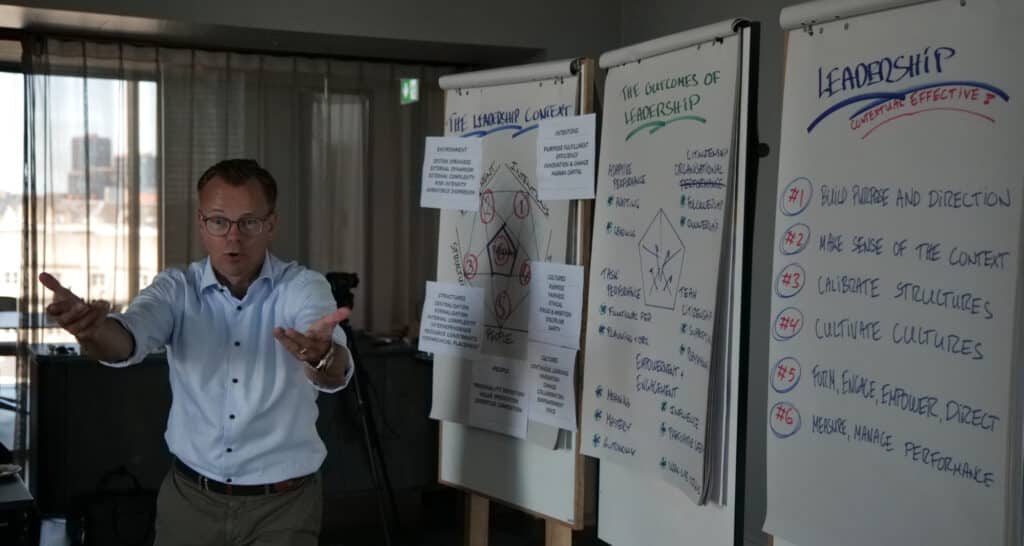
This site aims to deepen the knowledge about the contextual factors that influence leadership and organisational design to improve the performance of your business and promote more effective contextual leadership.
With more than thirty years of leadership and fifteen years of leadership consulting experience, Dr Torben Noerby shares learnings from his global research into leadership context, development and organisational design.
The Contextual Leader is my new book that tackles two of the biggest challenges leaders face: how to align leadership with the organizational context and how to structure the organization for optimal performance.
Insights and advice on leadership context and effective contextual leadership from experts across the globe
Heidrun R. Marstein, Cand. Polit., Chief Human Resource Officer, GK Gruppen, Norway
On Purpose Intention:
“During the last 3-4 years, our company’s purpose has become the most important factor in attracting new employees. A clear purpose that adds meaning to work is a competitive advantage now and even more so in the future.”
Lars Sønderby, MSc, Chief Financial Officer, Randers Municipality, Denmark
On Safety Culture:
“As a leader, your employees’ health and safety must be a No. 1 priority – ‘we leave no one behind’. That creates trust and knowing that your employees will do their absolute best for you and solve the tasks you give them.”
Valerie Khan, Vice President of Human Resources, Jones DesLauriers Insurance, Canada
On Voice Culture:
“The ability to challenge and spar rather than group think can support continuous improvement. A leader’s ability to open up to differing views and ideas can definitely help deliver better outcomes.”
Dr. Donald Chick, President & CEO, New Synergist Consulting, USA
On Collaboration Culture:
“Trust is a force multiplier in terms of productivity and collaboration.”
Magnus Röstlund, MBA, Vice President, Head of Engineering, NKT, Sweden
On Continuous Learning Culture:
“I did my Henley MBA thesis on this. Companies successful in continuous improvement have full backup from the top leadership who takes the task of CI seriously. Without such support, you fail. CI has to be built into the daily work as a culture by the leaders.”
Joe Manget, Chair and Chief Executive Officer, Edgewood Health Network, Canada
On Expertise Composition:
“Expertise helps you make the right decisions faster. So, to empower the organisation, build expertise.”
Henrik Gildberg, MSc, Army Major, Head of Command Course at Royal Danish Defense Academy, Denmark
On Fairness Culture:
“Fair processes and treatment are foundations for trust in the organisation!”
Caroline van Nieuwkerk, Master of law, Executive Board member HR and Sustainability, Van Leeuwen Pipe and Tube Group, The Netherlands
On Resource Constraints:
“Resource restraints will always be there. The constraints can be managed by making deliberate choices of the most critical focus areas and deciding what not to do. Deselecting is a vital leadership discipline. If a leader fails in this area, employees will experience stress and perform less well.”
Peter-Paul Gross, PhD, Director Talent Management & Organizational Development, ISS Facility Services GmbH, Germany
On Interdependence:
“Interdependence requires collaboration. Leaders must liaise and align with leaders in other functions and departments to set the organisation up to perform.”
Valerie Khan, Vice President of Human Resources, Jones DesLauriers Insurance, Canada
On Culture:
“Working in a strong and embedded culture can make it extremely difficult to shift the needle when the culture is no longer fit for purpose. It can be done but takes time, patience and strong leadership skills.”
Joe Manget, Chair and Chief Executive Officer, Edgewood Health Network, Canada
On Empowerment Culture:
“Empowerment is key to accelerating innovation and performance by placing decision-making in the hands of those with the most information to make the right decisions. But accountability must also follow.”
Jason W. Hoffman, Chief People Officer & Senior Vice President, People & Culture, Yield Engineering Systems, USA
On Workforce Dispersion:
“Remote leadership requires a different approach to be fully effective. Communication around expectations, accountability, priorities, etc., needs to be more explicit, with a higher frequency and formalised if not in close proximity to colleagues.”
Dr. Candice Chow, Assistant Professor of Strategic Management, DeGroote School of Business, McMaster University, Canada
On Discipline Culture:
“Diligence and discipline can impact performance outcomes for sure. It can also have an adverse effect if an innovative capability is key and the voice culture is not strong enough.”
Bob Markey, Senior Director, Talent Acquisition, Sikich, USA
On Internal Complexity:
“Good leaders break down complexity and make things simple. In simplicity, there is success. ”
Erik Roesen Larsen, Head of Health, Safety, Security and Environment, Innargi, Denmark
On Risk Intensity:
“How well you perform in high risk intensity depends on how mature your organisation is when it comes to recognising risks and hazards, appreciating them, accepting them and dealing with them. In a less risk mature organisation, some leaders think they can avoid all risks and ‘play not to lose’, resulting in subpar performance. Leaders have to build risk maturity.”
Jesper K. B. Ritz, Vice President, People & Culture, South Europe, Middle East & Africa, Vestas, Spain
On Hierarchical Placement:
“Leadership behaviour should change when moved to C-level from lower leadership levels as the demands for being effective includes a shift from shorter- to longer-term focus.”
Jay L. Brand, PhD, Professor of Leadership & Organizational Studies, Director Leadership PhD program, School of Leadership, Andrews University, USA
On Change Culture:
“When it comes to change, the leader’s behaviour and consistency in this regard are far more important than formal, official policies. People follow people in change, and building a change culture comes down to leader authenticity.”
James Jessup, APAC Sales and Solutions Lead, CBRE Asia Pacific, Singapore
On Formalisation:
“The effectiveness of formalisation depends on the maturity and quality of the team being led. A low maturity of the team may require more formalisation to be effective, whereas a more mature team can flourish with less formalisation and freedom carried by their expertise.”
Jeff Miller, PhD, Faculty at Creighton University and Greenleaf Center for Servant Leadership, USA
On Efficiency Intention:
“Pursuing efficiency should not lead to a singular focus on individual task performance, as this can have negative implications if it neglects the focus on teamwork, collaboration and relationships.”
Dr. Candice Chow, Assistant Professor of Strategic Management, DeGroote School of Business, McMaster University, Canada
On Personality Composition:
“Leaders should be cognizant of the implications of people composition to strategies and execution as different composition has their strengths and weaknesses. Especially when changing intentions, leadership should focus on staffing to ensure the right composition for the strategy.”
Mike Frausing, CEO & Owner at Andvari Holdings Pte Ltd, Singapore
On Shaping Context:
“The organisation will look up to the leader to see if he or she is “living the culture” …..if not, they are not likely to follow the rules. It’s critical that the leader is a good example and “walks the talk.””
Mauricio Menasche, MSc, Founder M2 Consulting, Portugal
On Innovation Culture:
“The role of leadership is critical for innovation as it can bring a lot of fear as people will need to move out of their comfort zone.”
W. James (Jim) Weese, Ph.D, Author of The 5C Leader: Exceptional Leadership Practices for Extraordinary Times and Professor of Leadership at Western University in London, Ontario, Canada
On Human Capital Intention:
“To leverage the development of human capital as a performance driver, the leader must continually review metrics and the performance of his or her direct reports and reflect on progress. Ironically, many in leadership roles get too busy and lose their focus, clarity, and sharpness in honing the quality of their people base.”
Amanda Bullough, PhD, Associate Professor, Management & Global Leadership, Principal Co-investigator, GLOBE Project: GLOBE 2020, University of Delaware, USA
On External Complexity:
“The more elements influencing decision-making and the greater the differences between them, the more complex the external environment is, and the more challenging leadership becomes.”
Ales Jazbec, MBA, Senior Director Product Portfolio and Business Development, Danfoss, Slovenia
On Ethical Culture:
“Strong ethical conduct culture builds trust in the organisation and its leaders.”
Lene Groth, Chief Human Resources Officer, STARK Group, Denmark
On Purpose Culture:
“It can be very difficult to strengthen any part of the culture if the whole system is not working in this direction. You can do something by inspiring people to fulfill the company’s purpose, but if the system is not able to live up to the purpose’s promises, it isn’t easy.”
Jay L. Brand, PhD, Professor of Leadership & Organizational Studies, Director Leadership PhD program, School of Leadership, Andrews University, USA
On Innovation Intention:
“When the organisation wants to innovate in a running operation, the middle managers need to balance the attention to ‘operational efficiencies’ and the areas open to learning, experimentation, creativity and innovation.”
Serdar Ulger, MSc, International Top Management Executive, Turkey
On Focus & Ambition Culture:
“To cope with external complexity is the job of leadership, and it should be absorbed by leaders gradually from top to bottom. Clarity should go up as you go down in the organisation. As long as the priorities, messages and direction are clear, the organisation can still perform very well.”
Leadership Context and Contextual Leadership
Research-based practical insights about how to lead effectively in different contexts.
The insights shared on this site flow from Dr Torben Noerby’s research into leadership context involving over 125 experts on leadership across industries, functions and geographies.
From around the globe, tenured leaders, human resource professionals and researchers have provided their assessment of which contextual factors matter most for contextual leadership and organisational design for improved performance.
Learn more about the book “The Contextual Leader”, the leader’s manual for exercising effective contextual leadership.
To handle the variation of context faced by leaders across industries, functions, geographies and levels, the research into contextual leadership needed to be designed to reflect this complexity.
A novel approach, building on well-proved research methodologies, allowed the research of this multi-faceted area.
Our research participants are:
30+ experts in each of three panels; leaders, human resource professionals and external consultants, and academic researchers.
38 held a doctoral degree, and 27% were female.
25 nationalities across 26 different countries.
Experienced in working across 13 regions, e.g. Eastern Asia, Northern America, Southern Europe and the Middle East.
Hold experience across 13 functional groups, e.g. finance and accounting, operations, or sales and marketing.
Work across 64 different industries, e.g. banking, food production, government or medical devices.
On November 12th, the book The Contextual Leader – Match and Shape Your Leadership Context for Organizational Performance will be out. Until it is out, you can try the Leadership Context Inventory.
Discover articles and videos on the findings from the Leadership Context Studies. In the articles, you get expert insight and advice about the contextual factors a leader must consider to lead effectively.
If you want to contribute insights or articles, please do not hesitate to get in touch or sign up to read updates
If you are a leader, I invite you to check out the book The Contextual Leader
If you are a leader and want to learn more about Contextual Leadership, please look at the book The Contextual Leader – you can download the first two chapters by signing up below.
When you buy the book, you get a free trial of The Leadership Context Inventory (LCI) and access to additional free resources. You can see sample reports in the Products section. The free trial will provide the short report version with the diagnoses of your specific leadership context.
The Contextual Leader is a book for senior leaders and middle managers who lead teams, departments, organisations or processes cutting across a matrix. It is based on doctoral research and twenty years of international leadership consulting experience. The book challenges the assumption that leadership is only about person-to-person influence and demonstrates how the organisational context should be actively shaped through leader-led interventions to set the organisation up for success.
If you are a leader, I invite you to check out the book The Contextual Leader
If you are a leader and want to learn more about Contextual Leadership, please look at the book The Contextual Leader – you can download the first two chapters by signing up below.
When you buy the book, you get a free trial of The Leadership Context Inventory (LCI) and access to additional free resources. You can see sample reports in the Products section. The free trial will provide the short report version with the diagnoses of your specific leadership context.
The Contextual Leader is a book for senior leaders and middle managers who lead teams, departments, organisations or processes cutting across a matrix. It is based on doctoral research and twenty years of international leadership consulting experience. The book challenges the assumption that leadership is only about person-to-person influence and demonstrates how the organisational context should be actively shaped through leader-led interventions to set the organisation up for success.
To provide the best experiences, we use technologies like cookies to store and/or access device information. Consenting to these technologies will allow us to process data such as browsing behaviour or unique IDs on this site. Not consenting or withdrawing consent, may adversely affect certain features and functions. Read more in our Privacy Policy.
Functional
Always active
The technical storage or access is strictly necessary for the legitimate purpose of enabling the use of a specific service explicitly requested by the subscriber or user, or for the sole purpose of carrying out the transmission of a communication over an electronic communications network.
Preferences
The technical storage or access is necessary for the legitimate purpose of storing preferences that are not requested by the subscriber or user.
Statistics
The technical storage or access that is used exclusively for statistical purposes.The technical storage or access that is used exclusively for anonymous statistical purposes. Without a subpoena, voluntary compliance on the part of your Internet Service Provider, or additional records from a third party, information stored or retrieved for this purpose alone cannot usually be used to identify you.
Marketing
The technical storage or access is required to create user profiles to send advertising, or to track the user on a website or across several websites for similar marketing purposes.

To provide the best experiences, we use technologies like cookies to store and/or access device information. Consenting to these technologies will allow us to process data such as browsing behaviour or unique IDs on this site. Not consenting or withdrawing consent, may adversely affect certain features and functions.
Functional
Always active
The technical storage or access is strictly necessary for the legitimate purpose of enabling the use of a specific service explicitly requested by the subscriber or user, or for the sole purpose of carrying out the transmission of a communication over an electronic communications network.
Preferences
The technical storage or access is necessary for the legitimate purpose of storing preferences that are not requested by the subscriber or user.
Statistics
The technical storage or access that is used exclusively for statistical purposes.The technical storage or access that is used exclusively for anonymous statistical purposes. Without a subpoena, voluntary compliance on the part of your Internet Service Provider, or additional records from a third party, information stored or retrieved for this purpose alone cannot usually be used to identify you.
Marketing
The technical storage or access is required to create user profiles to send advertising, or to track the user on a website or across several websites for similar marketing purposes.