About Torben Nørby
Practitioner, Researcher & Contextual Leadership Expert
I have been a leader since 1990 – the first ten years as an officer in the Danish Army. I have been a leadership consultant, working with leadership and organisational development since 2000.
I spent the first seven years of leadership development employed at Salling Group – the largest Danish Retail Group. Then, I worked forDanfoss – a global provider of industrial hydraulics, heating, cooling and electrical drives. Since 2007 in People & Performance, serving international clients across various industries.
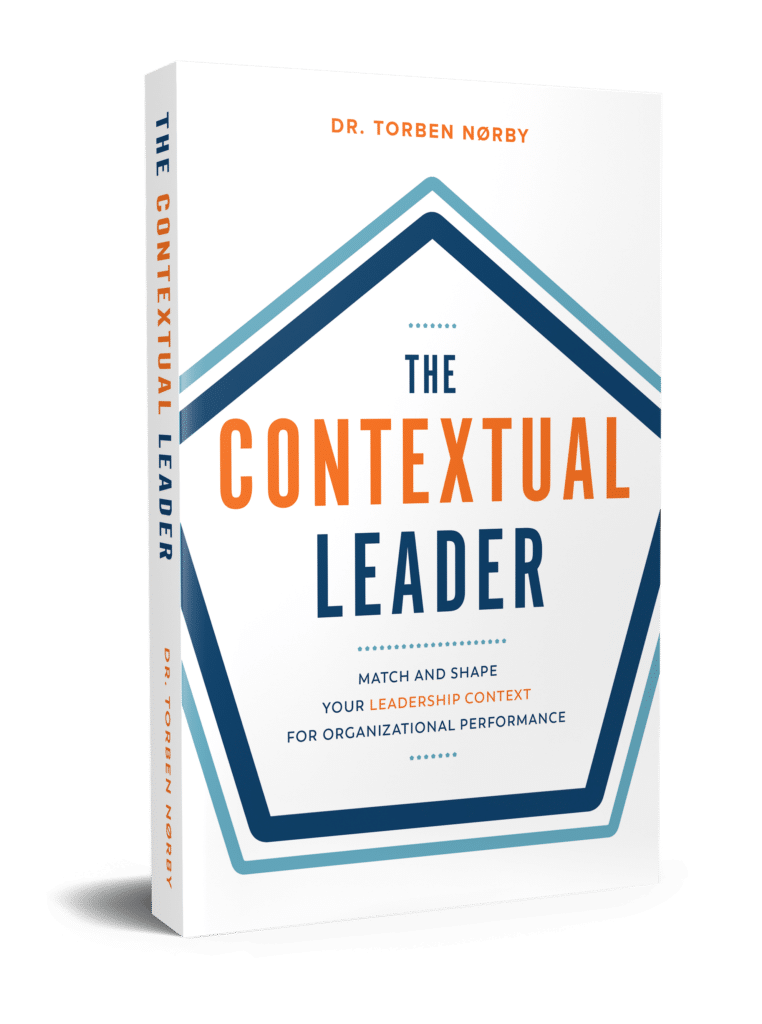
In 2021, I completed a Doctorate specialising in Contextual Leadership at the Henley Business School in the UK. The research led to writing the book The Contextual Leader – Match and Shape Your Leadership Context for Organizational Performance. It is a manual on exercising contextual leadership and shaping the context to set your organisation up for success.
The Contextual Leader – Out Now
The Contextual Leader is my new book that tackles two of the biggest challenges leaders face: how to align leadership with the organizational context and how to structure the organization for optimal performance.
Why did I become interested in Contextual Leadership?
In my years as an executive leadership consultant, I have learned about and used multiple useful frameworks addressing parts of the leadership context.
For example, the GLOBE framework for understanding the effect of national culture on leadership. Or the VUCA framework, which assists in understanding contextual effects from the external environment. However, without a coherent approach, the complexity is left to leaders and leadership developers, who must rely on experience to navigate the leadership context and the many disparate frameworks.
My appetite and frustration led me to research the leadership context more rigorously and in-depth.
Along with consulting, in late 2016, I joined Henley’s Doctor of Business Administration Programme, which I completed in 2021. My research was and is, focused on leadership context and its effects on effective leadership. My experience as an external executive consultant has been an integrated part enabling researching the complexity of the dynamics between context, leadership and performance.
Insights from the Global Leadership Context Study
Insights and advice on leadership context and effective contextual leadership from experts across the globe
Greg Daniel, MBA, Global Alliance Director, CBRE Global Workplace Solutions (GWS), Ireland
Greg Daniel, MBA, Global Alliance Director, CBRE Global Workplace Solutions (GWS), Ireland
On Resource Constraints:
“A leader must create a healthy resource tension to drive efficiency and improvement. Actively constraining resources can help focus on the most value-adding tasks, ensuring that the resources employed are productive and efficient.”
Melodena Stephens, PhD, Professor Innovation & Technology Governance, Mohammed Bin Rashid School of Goverment, UAE
Melodena Stephens, PhD, Professor Innovation & Technology Governance, Mohammed Bin Rashid School of Goverment, UAE
On External Dynamism:
“In our dynamic world, more and more crisis is a norm, and this point overlaps with resilience. A leader who cannot “bounce back” from an issue will face oblivion.”
Jordi Escartín, PhD, Visiting Professor King´s College London, Advisory Board Member, Systemic Coach & Consultant
Jordi Escartín, PhD, Visiting Professor King´s College London, Advisory Board Member, Systemic Coach & Consultant
On Ethical Culture:
“Leaders set the line for ethics by doing right as role models. And taking the necessary decisions when others do not follow the standard.”
Benny G. Jakobsen, Senior Vice President, Head of Executive & Global HR Business partnering, Legal & Employee Relations, Ørsted, Denmark
Benny G. Jakobsen, Senior Vice President, Head of Executive & Global HR Business partnering, Legal & Employee Relations, Ørsted, Denmark
On Internal Complexity:
“The business complexity, the way responsibility and accountability are delegated and aligned, and how signing rights and authority are implemented impact leadership and employee performance. Through structure, processes, clear delegation of authority, responsibility and accountability, leaders can decrease internal complexity or the opposite if not!”
Antonio Jimenez, EMBA, Regional Chief Financial Officer Latin America, VML, USA
Antonio Jimenez, EMBA, Regional Chief Financial Officer Latin America, VML, USA
On Empowerment Culture:
“There’s nothing more powerful than empowering people and letting them deliver. This is when leaders truly find the sweet spot of developing professionals. This context can be promoted from the top and need to be broadly supported by leadership in the company.”
Anette Papuga, EMBA, Chief People Officer, Maersk Tankers, Denmark
Anette Papuga, EMBA, Chief People Officer, Maersk Tankers, Denmark
On Fairness Culture:
“Perceived fairness is about aligning expectations of clear principles to drive the same perception of what is right and fair in the workplace. Also, I believe it is a matter of leaders leading with integrity and showing what the principles mean in words and actions.”
Carl Fredrik Langård-Bjor, Group EVP & Group Chief Commercial & Revenue Officer, ISS Global, CEO ISS Norway
Carl Fredrik Langård-Bjor, Group EVP & Group Chief Commercial & Revenue Officer, ISS Global, CEO ISS Norway
On Workforce Dispersion:
“Physical distance can both be a hinder and a help. It is hindering because the number of interactions is often more limited. Helping because the level of the interactions is often structured, planned and with a clear purpose.”
Erik Roesen Larsen, Head of HSSEQ, Ramboll, Denmark
Erik Roesen Larsen, Head of HSSEQ, Ramboll, Denmark
On Voice Culture:
“Leaders need to be brave enough to spark and allow for productive discussions. Be comfortable with discussions and create a culture where disagreements are good. Consensus without productive discussions creates stupidity!”
Jeff Miller, PhD, Faculty, Interdisciplinary Leadership Doctoral Program at Creighton University, USA
Jeff Miller, PhD, Faculty, Interdisciplinary Leadership Doctoral Program at Creighton University, USA
On Innovation Culture:
“Building an innovation culture basically comes down to whether experimentation is encouraged and celebrated or discouraged and punished.”
Dr. Deborah Koland, Strategist, Professor, Researcher, Writer and Catalyst, Deborah Koland LLC, USA
Dr. Deborah Koland, Strategist, Professor, Researcher, Writer and Catalyst, Deborah Koland LLC, USA
On Efficiency Intention:
“Anytime an organisation operates under a condition of “process to profits” – pursuing efficiency, it will drive leadership behaviours to this end, meaning less autonomy for the doers. The leaders should stay aware of the potential adverse effect of less autonomy on motivation.”
Dr. Clive Roland Boddy, Associate Professor in Management, Anglia Ruskin University, Cambridge, England
Dr. Clive Roland Boddy, Associate Professor in Management, Anglia Ruskin University, Cambridge, England
On Expertise Composition:
“If a leader leads employees outside the leader’s area of expertise, the leader should shift towards a transformational and consulting leadership approach. ”
Dorthe Rønnau, MSc, Business, Leadership & Organisation development advisor, Denmark
Dorthe Rønnau, MSc, Business, Leadership & Organisation development advisor, Denmark
On Interdependence:
“I see the leader as a boundary facilitator/manager “connecting the dots.” This is a key role in facilitating that interdependence does not end up as roadblocks or excuses for individual performance problems.”
Carsten Højlund, Group Chief Financial Officer, Faerch Group, Denmark
Carsten Højlund, Group Chief Financial Officer, Faerch Group, Denmark
On Formalisation:
“Formalisation can be a strong driver of effectiveness and efficiency in the right setting. I think leadership has a key influence on how formalisation is perceived – as a constraint or enabler. ”
Serdar Ulger, MSc, International Top Management Executive, Turkey
Serdar Ulger, MSc, International Top Management Executive, Turkey
On Hierarchical Placement:
“At every level, the expectations of a leader are different. So, a leader performing well in her current role is not necessarily good for the next level. So, leaders must acquire the required skills for every level.”
“Resource constraints should lead the leader and the employees to focus, prioritise and align goals and efforts to ensure that time is spent on the most value-adding activities.”
Joep Bovens, Independent Advisor and Interim Executive, The Netherlands
Joep Bovens, Independent Advisor and Interim Executive, The Netherlands
On Shaping Context:
“Being a role model as a leader drives behaviour. It’s embedded in human DNA. Everyone (sub)consciously will deploy behaviour to meet their manager’s and significant peers’ expectations. If these expectations are set by authentic behaviour that supports collaboration and performance, role modelling will have a substantial positive effect.”
Jesper Uldbjerg, Senior Vice President, Group Logistics, Danish Crown, Denmark
Jesper Uldbjerg, Senior Vice President, Group Logistics, Danish Crown, Denmark
On External Complexity:
“From a textbook example, complexity should hinder performance. However, sometimes higher complexity improves the decisions when leaders take extra time to make the right decision in the first place. Also, if the risk of being wrong is higher, many employees are less eager to make their own decisions. They tend to consult each other and the leaders more. ”
Mike Frausing, CEO & Owner at Andvari Holdings Pte Ltd, Singapore
Mike Frausing, CEO & Owner at Andvari Holdings Pte Ltd, Singapore
On Focus & Ambition Culture:
“The best way is always when the organisation hold each other accountable rather than when accountability depends on the leader alone.”
Get alerts as new insights are released
If you want to learn about contextual leadership from my blogs or try out the Leadership Context Inventory, please sign up
My experience as a Leadership
Consultant working in many different contexts
With the exposure to different contexts, my appetite for understanding effective contextual leadership grew over the years. At the same time, I found no framework for leadership context to help explain the differences in context across functions, organisations, geographies and industries.
Assisting in growing more than 25 Senior Leadership Teams and Boards towards higher levels of trust and cohesiveness. Developing their capacity to work from a common purpose, shape the organisational context for future performance and commit the organisation to strategic execution.
Numerous interventions to strengthen empowerment, strategy deployment and execution power. Projects improving cross-organisational collaboration and shaping organisational cultures and behaviours. Programmes increasing organisational engagement, change capacity, customer centricity and cross-cultural performance.
Implementing more than 15 Corporate Leadership Academies, including tailoring leadership principles, toolboxes and training to the companies’ strategic aspirations. Engaging in the training, coaching and discussion about how to make leadership work in real life with thousands of leaders.
Facilitating the people and culture change side of eight large-scale organisational transformations, including integrating, separating and restructuring units. These transformations have encompassed establishing organisational designs, governance, leadership practices and culture aligned to the operating model and supporting the strategy realisation.
Learn more about my work as a consultant at People & Performance, a leadership and business development consultancy
How understanding Leadership Context can help your organisation
The importance of pinpointing the key contextual levers and focusing the efforts to move the needle through involvement is a key reason for my interest in contextual leadership. Senior leaders cannot ignore the differences between factors influencing performance, engagement and leadership across their organisation. They need an approach to identify and influence the key factors, which has been the purpose of my research efforts since 2016.
If you are a leader and want to read the first two chapters of the book The Contextual Leader, please sign up
When you buy the book, you also get a free trial of The Leadership Context Inventory (LCI) and access to additional free resources. You can see sample reports in the Products section. The free trial will provide the short report version with the diagnoses of your specific leadership context.
The Contextual Leader is a book for senior leaders and middle managers who lead teams, departments, organisations or processes cutting across a matrix. It is based on doctoral research and twenty years of international leadership consulting experience. The book challenges the assumption that leadership is only about person-to-person influence and demonstrates how the organisational context should be actively shaped through leader-led interventions to set the organisation up for success.
To provide the best experiences, we use technologies like cookies to store and/or access device information. Consenting to these technologies will allow us to process data such as browsing behaviour or unique IDs on this site. Not consenting or withdrawing consent, may adversely affect certain features and functions. Read more in our Privacy Policy.
Functional
Always active
The technical storage or access is strictly necessary for the legitimate purpose of enabling the use of a specific service explicitly requested by the subscriber or user, or for the sole purpose of carrying out the transmission of a communication over an electronic communications network.
Preferences
The technical storage or access is necessary for the legitimate purpose of storing preferences that are not requested by the subscriber or user.
Statistics
The technical storage or access that is used exclusively for statistical purposes.The technical storage or access that is used exclusively for anonymous statistical purposes. Without a subpoena, voluntary compliance on the part of your Internet Service Provider, or additional records from a third party, information stored or retrieved for this purpose alone cannot usually be used to identify you.
Marketing
The technical storage or access is required to create user profiles to send advertising, or to track the user on a website or across several websites for similar marketing purposes.
To provide the best experiences, we use technologies like cookies to store and/or access device information. Consenting to these technologies will allow us to process data such as browsing behaviour or unique IDs on this site. Not consenting or withdrawing consent, may adversely affect certain features and functions.
Functional
Always active
The technical storage or access is strictly necessary for the legitimate purpose of enabling the use of a specific service explicitly requested by the subscriber or user, or for the sole purpose of carrying out the transmission of a communication over an electronic communications network.
Preferences
The technical storage or access is necessary for the legitimate purpose of storing preferences that are not requested by the subscriber or user.
Statistics
The technical storage or access that is used exclusively for statistical purposes.The technical storage or access that is used exclusively for anonymous statistical purposes. Without a subpoena, voluntary compliance on the part of your Internet Service Provider, or additional records from a third party, information stored or retrieved for this purpose alone cannot usually be used to identify you.
Marketing
The technical storage or access is required to create user profiles to send advertising, or to track the user on a website or across several websites for similar marketing purposes.